
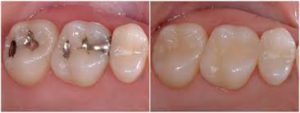
Unfortunately, white fillings are not available on biting surfaces of back teeth on the NHS and they tend to be more expensive. There are many reasons for this. The newer white fillings are very expensive to purchase, the bond used is also a high quality material that is costly. White fillings are technically more difficult to place and the dentist will book of more time to complete this type of filling.
A well placed white filling can make the tooth look natural as if there is no filling there at all.
If you would like to consider white fillings call 01418862116
Composite Bonding is a technique to change the outline of teeth to change their shape by adding white filling to the tooth or teeth. This technique allows the tooth to look more the way you want it to. The procedure is fairly simple and usually does not require any drilling of the tooth or injections.

There are certain limitations to this technique and other options such as veneers or crowns may be required.
Porcelain veneers are a thin layer of porcelain bonded to the front of upper or lower front teeth. The porcelain is made to look like a natural tooth and is available in many different shades to fit in with your own teeth.
The procedure involves removing a thin layer of enamel to compensate for the veneer. the dentist will then scan the prepared teeth and send to the laboratory for a technician to make your customised veneer.
Porcelain veneers can be great for restoring the tooth to its natural form but it can also be used to improve stained or heavily filled front teeth. If a veneer is not suitable, a crown may be required instead. The procedure is much the same but crowns require removal of slightly more tooth and instead of just the front teeth that veneers are indicated for, crowns can be used in any part of the mouth.

A dental crown, otherwise known as a cap is a tooth shaped piece of porcelain that is placed over a natural tooth. Crowns are usually placed over heavily filled teeth and teeth that have broken fractured or chipped. Crowns can be used to improve the appearance of teeth that have chipped or have lost height due to grinding.
Crowns can last for years if properly cared for. Speak to the dentist regarding crowns as he will be able to advise you on the best course of treatment.
If you wish to discuss this further book an exam, 01418862116